The Kerschen Family Story
This is the story of the Kerschen family from Michigan, with Luxembourg roots--not to be confused with the Kansas Kerschen family, which is an entirely different branch with its own unique history.
No, the Michigan Kerschen family starts its story in our home country of Luxembourg at the start of the eighteenth century with the birth of a boy named Joannus--the same man who would spawn both the Michigan and Kansas branches of the Kerschen tree.
The Early Kerschen Men: Many Lost Wives and a Fuzzy History
In the year 1700, or thereabout, my great x6 grandfather, Joannus Balthesarius Kerschen was born in a southwestern area of Luxembourg near the Moselle River--an area that is now part of Moselle, France. He first married a woman named Magdalena Klensh (the matriarch of the Kansas line), in about 1722, and had several children by her in quick succession, which sadly put an end to Magdalena.
His second marriage was to a woman named Elisabeth Zeitgen (or possibly Hentgen--records from this era are quite fuzzy and very French) in about 1728. They also had several children together, and for our particular focus, we are most interested in their son, Joannus Carolus Kerschen, born December 31, 1732 in Lallingen, Luxembourg. And this marks the beginning of our Michigan line.
Joannus-the-younger may well have waited until much later in life to marry, but likely not, given the era. But, if he had an earlier wife (or wives), we know not of their brief existence. The only wife we are aware of is his much younger bride, Anna Zeimes, who was about 23 years old when she married the 41 year-old Joannus in about 1773. The couple had at least five children, allegedly including late-comer Francois Kerschen, who was supposedly born in about 1796--though this would have made both of his parents remarkably old to produce another bundle of joy, and one wonders if the historical records haven't skipped a generation and noted Francois' father as his brother!
Francois Kerschen and a Changing World
It seems that the life of young Francois must have been one of uncertainty and strife, as he was born in the midst of the French Revolution, which was being waged mere miles from his family's home in southwestern Luxembourg. During his formative years, Napoleon was conquering much of the world, including portions of Luxembourg. Against the backdrop of all of this uncertainty, 20 year-old Francois met and married a young woman named Catherine Weyland on November 19, 1816 in Kayl Commune, Luxembourg. The couple never left Kayl Commune and raised at least two children there: Marie Kerschen and Joseph Kerschen. Having only the two children was quite unusual for the time, and since it is unknown how long Catherine lived, perhaps she left this world quite early. Our current records do not indicate that Francois ever remarried or had additional children, whatever the case.
An Unlucky Start for Joseph Kerschen
Francois lived long enough to see his (presumably) only son Joseph marry a young Annie Hoffeld on February 2, 1848. Francois was even able to meet his two grandsons by Annie, Nicholas Kerschen and Michael Kerschen. Unfortunately, the family had very ill fortune, and the young couple lost their son, 4 year-old Nicholas, on November 2, 1854. Less than five years later, Annie Hoffeld passed away sometime in 1859. About two years after that, Joseph lost his father, Francois on March 19, 1861.
Joseph Kerschen's New Family
Joseph found a new bride and mother for his remaining son, Michael, a short time later. On March 2, 1863, 44 year-old Joseph married 24 year-old Catherine Goldschmidt (my great-great-great grandmother). Immediately, the couple began reproducing, and almost exactly nine months after their wedding, they welcomed their first child, Marie Catherine Kerschen on December 8, 1863.
Then on July 16, 1865, Joseph's only remaining child from his first marriage, Michael Kerschen, passed away at the age of 13. This must have been especially taxing on stepmother Catherine, as she was beginning her second trimester of pregnancy with next child, John Baptiste Kerschen (b. 6 Jan, 1866). Two more boys quickly followed for the family: Nicholas Kerschen (b. 11 Nov., 1867) and Johann "John" Kerschen (b. 7 Jan, 1869). For reasons unknown, there is a hiatus in the baby-making between Joseph and his wife from 1869 to 1872. It could be that there were unrecorded babies lost during that time, or there is the outside chance that farmer Joseph got entangled in the Franco-Prussian war (1870-1871), though, officially, Luxembourg tried to remain neutral. Whatever the causes, by 1872, the couple welcomed daughter Marguerite Kerschen (b. 7 Feb, 1872). Another gap in reproduction followed, until the arrival of Maria Kerschen (b. 23 Feb, 1877), followed by Anne Kerschen (b. 13 Mar, 1879). Their next child, Jeanette "Jennie" Kerschen, was born in 1880 in Paris, France. Records suggest that the couple was not living in France, and it may have been chance that mother Catherine was visiting the major city when Jennie arrived.
Later that year, on July 1, 1880, 15 month-old baby daughter Anne passed away of unknown causes. After that, the couple would have just one more child, Catherina Kerschen (b. 25 July, 1882).
Argentine Fever
By the time the couple had their final child in 1882, Joseph was already 63 years old and most likely struggling to make ends meet. Luxembourg, though now a thriving modern nation, was, at the time, a poor agrarian country with too many people and not enough land to farm. Consequently, Luxembourg was becoming more and more industrialized, and many rural families--including our Kerschen family--resisted the changes. So when talk swept around Luxembourg that there were great agricultural economic opportunities awaiting in Argentina, Joseph became interested. The phenomenon of the time has been referred to as Argentinienfieber, which translates to "Argentine Fever", and it was the cause of a mass exodus out of Luxembourg from 1888 to 1890. During those years, more than one thousand citizens of Luxembourg sailed for Argentina--a group that made up about .5% of the entire Luxembourg population. This "fever" was not happenstance, of course. This was by the design of a wealthy Argentinian family of Spanish descent named Ayerza. Romulo Ayerza had inherited vast cattle-breeding lands from his father, Don Toribio de Ayerza, and decided that the best way to increase the value of the land was to colonize it with industrious German-speaking immigrants. He made several attempts to lure colonists to the property, but did not succeed until he turned to missionary Father Didier, a long-time Argentinian resident who was born in Dippach, Luxembourg. The Ayerza family had been great benefactors of Father Didier's Order, and so, upon hearing Romulo Ayerza's request in 1888, Father Didier contacted his nephew, Rev. Jean Baptiste Kirsch in Luxembourg to facilitate the forming of the colony. The young Rev. Kirsch was likely directly responsible for this Argentinienfieber--and, indirectly, the continent-hopping journey that my family would embark on during the next two decades.
An Adventure in Argentina: The San Antonio de Iraola Settlement, 1888-1891
By the end of 1888, Joseph had packed up his family--wife Catherine, and his eight children (Marie, John Baptiste, Nicholas, Johann, Maria, Jeanette, Catherina, and Marguerite), and sailed for Argentina.
The Kerschens may have sailed on the Koln-Bremen ship, of the Norddeutschen Lloyd line, from Antwerp to Buenos Aires (the passenger lists were all destroyed in the 1920s due to lack of storage). The eight-day trip across the ocean would have been under miserable conditions, causing the demise of many passengers. One passenger aboard the Koln-Bremen, wrote of tiny beds, loud conditions, and mass thievery. Those aboard were given soupy rice, undercooked white bread, watered-down coffee, and little else to survive on. By the time they arrived in Buenos Aires, many waited about two days before heading for their new home: The colony of San Antonio de Iraola. The settlement was a 16-hour railway ride away.
By all accounts, the entire Kerschen clan survived the voyage and arrived at the colony in early 1889. Though the new colonists were delighted to spot some rolling wheat fields on the Ayerza land, mostly they were given swampy, unforgiving soil to work with, much to the chagrin of the farmers. Still, the new inhabitants were excited to greet Father Nikolaus Schewbag from Luxembourg as their new minister, and a Mr. Bamberg as the local teacher. However, a lack of housing, food, and potable water made for a tense relationship between the colonists and the Ayerza family. Poor weather conditions hampered the crops, and worldwide economic downturn that had spanned the 1880s had finally reached the lands of South America.
In 1890, the eldest Kerschen daughter, Marie, married, presumably, a fellow colonist named Edward Willm--a man of French birth. The two began a family in Argentina, first with the birth of daughter Ana Willm in 1890, and then with son Charles "Carlos" Willm on December 2, 1892.
Over the next 2-3 years, many illnesses, including smallpox, typhoid, measles, and gastric bugs erupted, and the colonists had no physician in residence to turn to, with the job often falling to Father Schwebag. He was also the one who helped to bury those who didn't survive. Some orphans were shipped home to Luxembourg at the expense of the Ayerzas. The Kerschens were generally quite lucky, in that their large family remained quite intact through these lean years.
Conditions worsened when the generally sympathetic Commissioner Jean-Baptiste Kirsch was replaced by a new and more violent caretaker. Given that the Luxembourgers had collectively signed a six-year contract with the Ayerzas, they had no real leeway or leverage in getting the help or improvements they needed. The whole endeavor had become a miserable failure.
In 1891, all of the Kerschens packed up and sailed back to Luxembourg aboard the "Strasbourg". Only daughter Marie Willm stayed behind with her husband, Edward (by then, referred to as "Eduardo") and their children. The Ayerzas had released the Luxembourgers from their contracts, and most fled like the Kerschens. About half of the settlers moved to more favorable areas of Argentina. About 30% decided to make the move directly to the United States in hopes of finding prosperity there. And about 20% returned back home to Luxembourg. There is no marker today to designate where the colony was built, and where the lost loved ones were laid to rest.
The Kerschens Go Back to Europe, 1891
Shortly after the family's return, they opted to settle near Paris, France. This may well have been the influence of eldest son, John Baptiste Kerschen, who settled in Paris for work and wed Anna Ferron on May 8, 1892. By this point, the patriarch, Joseph was about 73 years old. No doubt the Argentina experiment had cost him many years off of his life, and he did not live long after seeing his family back to Europe. He passed away in about 1892, probably in France.
Meanwhile, John Baptiste and wife Anna began a family with the birth of Jeanette M. Kerschen in 1894, and then Edward J. Kerschen on November 26, 1895.
Back in Argentina, Marie and Eduardo Willm welcomed children Margaret Willm on July 17, 1893, Edward W. Willm in 1895, Sophie Willm in 1896, and Marie Mary Willm in 1897. The Willms stayed in South America and raised their children in the country through about 1898, when they returned to Europe. For most of their lives, the children primarily spoke Spanish, instead of the family's native French tongue.
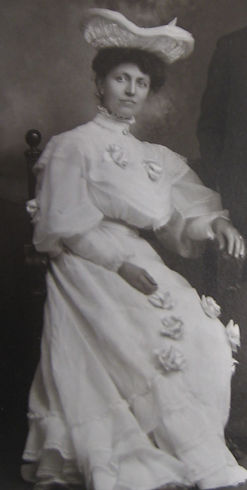
Catherine (Goldschmidt) Kerschen c. 1890s
Onward to the United States, 1893-1903
While John Baptiste may have found opportunity in France in about 1892, other members of the family may not have had similar fortune. We don't know who first had the idea to travel to the United States or why, but we can guess that son Johann may have been the driving forces.
Our research indicates that recently widowed mother Catherine was one of the first to arrive in the U.S., by sometime in 1892 or 1893, though her earliest trips are thus far undocumented.
1895
The earliest documented trip we know of to date was in May, 1895 when sisters Maria and Marguerite (my great-great grandmother) sailed together aboard La Normandie from Havre, France to New York, and then traveled to the Detroit area. They stayed for an unknown amount of time before returning to Luxembourg again.
1896
The news from America must have been encouraging, for in 1896, most of the remaining European Kerschen family joined their kin in the U.S. Nicholas and Catherina sailed alongside John Baptiste and his wife and children from Havre, France to New York aboard La Bourgogne. The logical presumption is that they were joining their mother Catherine, brother Johann, and sisters Maria and Marguerite who had all settled in the Detroit, Michigan area.
1897
By 1897, John Baptiste, working as a tailor, had purchased a home at 139 Catherine Street in Detroit, and Nicholas and his mother boarded
with him and his family that year. (Wife Anna and the children may have ventured back to Europe briefly around this time, but returned quickly, if that is the case.)
1900
By the turn of the 20th century, almost the entire Kerschen family of nine siblings and their mother had settled in Detroit, Michigan. We believe that sister Jeanette arrived in the U.S. by 1900. Only Marie still remained far from her family, still residing in Argentina.
1902
At some point in 1901 or 1902, mother Catherine and several of her children--Maria, Marguerite, and (probably) Catherina and Nicholas--returned to Europe for an unknown, brief amount of time. It may be that they traveled to visit the Willms, who had just relocated from Argentina to Luxembourg, and perhaps encouraged them to visit and meet their children. But by December of 1902, Catherine, Maria, and Marguerite were headed back to Michigan aboard La Champagne. As far as we know, this is the last time any of those three ladies saw the shores of Europe.
Catherina stayed behind and took up residence in Paris, working as a dressmaker by 1903. Nicholas also stayed in Europe, at least for a few more months.
1903
In the last known Kerschen trip from Europe to America, siblings Nicholas and Catherina left France behind to join their family. They sailed together in May aboard La Savoie.
The Last Kerschens in Luxembourg Tiptoe Through History
By about 1900, Marie (Kerschen) Willm and her husband Edward had given up on Argentinian life and headed back to Luxembourg. Oddly enough, this was just on the heels of her family departing, so the family remained separated for a time. By 1900 upon their return, the couple brought along 6 children: Charles, Margaret, Edward, Sophie, Marie, and Catherine Willm (eldest Ana sadly perished before this time). Another child, Nicholas Willm, followed in 1908 in Luxembourg.
The would only stay for about 12 years in Marie's homeland though. Before too long, the opportunities of America were too tempting, and the family decided to make the move.
Edward sailed first, bringing along his two eldest surviving children, Margaret and Charles Willm--who were 18 and 20, respectively--aboard the Lusitania on February 14, 1912. They departed Liverpool and arrived in New York just two months prior to the infamous Titanic disaster. Just a little more than 3 years later, the ship was infamously torpedoed and sank, taking the lives of most of the civilian passengers.
Instead of settling in Detroit, Edward Willm set up his family in Evansville, Indiana.
A little over a year later, Edward sent for his wife Marie and their younger children (Edward Jr., Sophie, Marie, Catherine, and Niklaus). Marie booked passage for herself, her kids, and her brother Johann, and the seven of them sailed aboard the Mauretania from Liverpool to New York in May, 1913. This was just 2 months before King George and Queen Mary of England toured the ship, and a little more than a year prior to the Mauretania playing a pivotal role in WWI.
As far as we know, that was the last time a Kerschen of this branch touched foot on Luxembourg soil...until June, 2017.
A Family Settled in Michigan
After settling in the Detroit area, the unmarried Kerschen children quickly found spouses and began families. Nicholas wed Christine Lochbihler on March 2, 1905 and supported his new family by continuing his work as a shoemaker. The couple would have at least one child, Arthur Henry Kerschen (b. 1 May, 1906). One of his descendants is the founder and manager of the Kerschen family history website, kerschen.org.
My great-great grandmother, Marguerite Kerschen married Joseph Magura on May 19, 1906 in Detroit. Joseph worked as a repairman for the Hupp Motor Car factory in Detroit in 1910. The two had at least two children: Anna Magura and Mary Margaret Magura (b. 21 Apr, 1908).
Not much is currently known about youngest child Catherina. At some point prior to 1914, she married a man named Webber, and they settled in Sans Couse, Ontario, where she remained for her entire life.
Johann Kerschen appears to never have married, and spent much of his first two decades away from Luxembourg bouncing from one sibling's home to another. After living with John Baptiste in the earliest days in the U.S., he joined sister Marie Willm in Evansville, Indiana from 1913-1914. Then after a brief stay with sister Catherina in Ontario, Johann went to stay with brother Nicholas back in Detroit. In 1920, Johann was working as a janitor at a Detroit auto factory.
Jeanette Kerschen settled into life in Michigan, working as a domestic servant in a Detroit home in 1906. She left her position by February, 1907 when she married Otto Weber in Detroit.
Almost nothing is known about Maria Kerschen after her 1902 arrival in the United States.
Kerschens at Rest
Matriarch Catherine lived until November 18, 1911, when she passed away of tuberculosis in Detroit, having last resided at 670 18th Street, Detroit. She was laid to rest at Mt. Olivet Cemetery in Detroit, as were most of her children in turn. Sadly, she did not live long enough to be reunited with her eldest child, Marie, in the United States.
John Baptiste and Nicholas were the first siblings to pass, both of heart disease. John Baptiste lived to age 68, passing on July 17, 1934 in Detroit. Nicholas departed on February 20, 1939 in Detroit of heart complications from influenza at the age of 72. Both were interred in the same cemetery as their mother, Mt. Olivet.
Johann Kerschen passed away on January 1, 1943 (age 74) , and only eight days later, his eldest sister, Marie Willm died on January 9, 1943 (age 80), both in Michigan. Their little sister, Jeanette (Kerschen) Weber passed a little over a year later, on June 7, 1944 of uterine cancer at the age of 60.
The fates of Maria and Catherina are currently unknown.
My great-great grandmother, Marguerite (Kerschen) Magura died on May 14, 1947 in Clawson, Michigan--possibly the last of her siblings to survive. She, too, was laid to rest at Mt. Olivet Cemetery.
Citizenship Lost and Reclaimed
On her dying day, Marguerite (Kerschen) Magura still probably believed herself to be a citizen of Luxembourg, as she had never sought U.S. citizenship for herself. After all, most women of the time saw no need in the costly chore, given that during the first couple of decades in her new country, she would not have been able to vote anyway, and it was traditional at the time for men to own the marital property. What Marguerite didn't realize is that many areas of Luxembourg, in an act to hastily reallocate local resources, often removed families from their citizenship rolls once they sailed for another country. This was not seen as malicious or problematic at the time, but rather, a pragmatic practice since families rarely ever returned once they departed their homeland (though the Kerschens had certainly proved this belief wrong, hadn't they?).
The problem, though, is that this inadvertently left thousands of Luxembourg women (and men) overseas without official citizenship of any nation at all. When this disenfranchisement was brought to light in the early twenty-first century, Luxembourg acknowledged the issue by temporarily offering the right for some qualifying descendants of Luxembourgers to reclaim their family citizenship. Over the course of the past couple years, this is what I have set out to do.
In June, 2017, I traveled with my husband and daughter to tour Luxembourg--my family's homeland--with the Luxembourg American Cultural Society. During this trip, I submitted my application for citizenship, and as of October, 2017, I am officially a dual citizen of the United States and Luxembourg. As is my daughter. And so will her children be.
